Last fall I shared about my transition from my leadership role at HOPE International. Since then, I’ve worked very part-time at HOPE and invested most of my waking hours in sustaining the lives of our four small children.
This season gave me a newfound appreciation for the role Alli served in our family for most of the last 12 years. And, it gives me tremendous respect for the moms and dads out there who spend their days whipping together PB&Js, brokering truces among warring siblings, and navigating the great carpool shuffle.
The actual work is not hard. Wiping butts and pouring bowls of cereal is not tactically difficult. But the compounding effect of dozens of these tasks every hour of every day for months exacts a real toll. The work is invisible to everyone aside from the small children who are often delightful, but often incredulous you might ask them to vacuum the very floors they’ve sullied. To all the full-time and part-time stay-at-home parents out there: You do hero’s work. Hold the line. Don’t let those whippersnappers unionize and boycott their chores today. Not on your watch.
The last nine months have also been gratifying in ways I struggle to fully verbalize. From morning tears about classmates who have chosen new friends to afternoon cackles at the pool, this season gave sacred glimpses into the joy and privilege of raising children. I love these kids immensely and loved the front-row seat this season afforded me to witness their creativity, courage, and wit.
With the kids now all in school and reaching age 40, I’m stepping into a new chapter. And, with that comes a complete change of scenery.
For the last 17 years, I’ve served at HOPE International in a variety of roles. It’s been such a joy to see the organization grow from less than thirty employees in just a few countries in 2006 to over 1,400 employees working across over 20 countries today. From serving just hundreds of hardworking entrepreneurs to today serving millions. In January, I will officially join the ranks of our amazing donors and volunteers championing HOPE without getting paid to do so.
And, starting next week, I’ll be starting a new role at EMJD Corporation, a 53-year-old sheet metal fabrication company located just a few minutes away from our home. There are a host of reasons why I’m excited about this change, but it starts with Luke and Jenna Galli, our longtime friends. Alli and I have been good friends with the Gallis for over a decade. They bought EMJD a few months ago and I’m looking forward to helping them and their amazing team in growing the business. In my role, I’ll support Luke with sales, marketing, special projects, and anything else that’s needed to help EMJD flourish.
I’m also excited about working in a small business that makes things. 11 years ago this month, Christianity Today took a risk on me and published my first real article on the impact a metal fabrication company can have on its employees, with the important products they make, and the communities where they serve. I’ve long been an advocate for the role small businesses like EMJD can have on society and now I get to experience it firsthand.
Finally, I’m grateful for a flexible arrangement allowing me to continue to manage the school carpooling schedule. In a fun perk, I get to work across the street from Alli, who is loving her journey of leading and building businesses with a great team at Marrow.
I remain HOPE’s biggest fan. I can’t wait to invest even more financially in the dreams of the men and women we serve as we live and proclaim the Gospel. God has been so gracious and good to HOPE and to me and I’m grateful for the capable colleagues that carry the baton into new frontiers.
I’m not entirely sure what will happen with this blog and writing in the future, but I’m grateful for the ways you’ve encouraged me along the way. At 40, I guess I’m now officially at the top of the hill, but I’m grateful for the journey up and for what lies ahead on the path down.
Today (!), we officially launched The Gift of Disillusionment, which I’ve worked on with Peter Greer over the past three years. The following acknowledgments show up in the book for a reason.
This endeavor, like the previous books we wrote together, is possible because of the amazing team surrounding us. While our names are on the spine, we unequivocally could not have done this without the support of our incredible team. We want to put the world’s biggest asterisk alongside our names as authors of this book. Like the leaders we featured in this book, we wrote this book from, with, and because of the community surrounding us.
Jill Heisey and Brianna Lapp served as collaborators, advisors, writers, editors, counselors (!), cheerleaders, and coaches from the genesis of the idea. More than any project we’ve undertaken, this one saw the book’s big ideas twist and turn over the course of our research. Jill and Brianna: Thank you for your patience, wisdom, and kindness throughout this harrowing journey! Your contributions to this book are innumerable, but it’s the steadfastness of your character and your enduring hope in Christ and in this project that we most cherish.
Our amazing interns and fellows—Sarah Woodard, Sarah Beth Spraggins, and Adrian Schunk—each joined at critical junctures in the journey. Sarah did significant foundational research for this project back. Sarah Beth helped us with early interviews and with the initial direction of the book. And Adrian carried the baton beautifully down the homestretch.
This is our third rodeo with our literary agent, Andrew Wolgemuth at Wolgemuth & Associates, and our editor, Andy McGuire at Bethany House. We are so fortunate to have these two leaders in our corner. Their professionalism and skill in their craft is evident, but it was their words of encouragement at key junctures that we appreciated most. Thanks for believing in us and for believing in this project.
Our families endured our personal journey from idealism through disillusionment to enduring hope over the course of writing this book. We both had moments of frustration, confusion, and exhaustion while trying to put this book together. They helped us navigate our disillusionment and find hope even in this project itself. We are so thankful for Laurel, Keith, Lili, Myles, and London and for Alli, Desmond, Abe, Juni, and Mack.
We each had foundational conversations early in the ideation process. Daniel Rice suggested we consider Jeremiah 17 as an anchor text. Dan Williams proposed we examine the ways disillusionment may be a gift. Many other friends and colleagues helped to strengthen our thinking and clarify our perspective.
On our own, we could not have met the amazing leaders we interviewed for this book. Our sincere thanks to Chad Hayward, Katelyn Beaty, Harlan VanOort, Chilobe Kalambo, Durwood Snead, Francis Kaitano, Lisa Espineli Chinn, Tim Hoiland, Rob Gailey, Tyler Green, Hunter Beaumont, Candy Sparks, and Lesly Jules for each opening their networks to us.
We’re grateful to the team of readers whose early edits, questions, and critiques made the book what it is. In particular, we’re grateful for Claire Stewart, Phil Smith, Pat Ryan, and Mark Cunningham. Thanks to Benj Petroelje for introducing us to Dr. Samuel Hildebrandt, a scholar and theologian whose invaluable understanding of and passion for Jeremiah helped to make sure we got Jeremiah right.
Our talented colleague Jeff Brown helped bring order from the chaos. His design of the journey illustrations used throughout the book enabled the book’s big ideas to finally arrange themselves. While the Fruit Loops metaphor did not make it into the book itself, it lives forever in these acknowledgments.
Finally, our thanks to our amazing interviewees, Florence Muindi, Bill Massaquoi, Dickens Thunde, Eris Labady, Dr. Michael Badriaki, Jo Anne Lyon, Christa Crawford, Farai Mutamiri, Camille Melki, Melba Maggay, Phil Thuma, Tita Evertsz, Chris Brewster, Marek Kucharski, Tass Saada, Lisa Johanon, Edouard Lassegue, Ann Saylor, and to Riaan.
I stepped onto Ukrainian soil for the first time as an earnest 23-year-old. With a full head of hair and freshly printed business cards in my bag, I visited HOPE’s work in southern Ukraine. In an email afterward to my friends and family, I shared a bunch of pictures of the spectacular sunflower fields, gushed about the cobble-stone port city of Odessa, and raved about Vitale–a seminary professor and translator–and Natalya–my colleague who hosted me during the stay.
Just six months after that trip, I returned to Ukraine. This time to Kyiv and then onto Zaporizhzhia. While there, I worked from HOPE’s offices alongside Andre Barkov and the rest of the HOPE Ukraine staff. Zaporizhzhia is an esteemed city for many reasons, but among others, it is the birthplace of HOPE International.
Over the last 25 years, HOPE has served over two million hardworking men and women across the globe, investing over $1.4 billion in their dreams for their future. During that time, we’ve opened dozens of bank branch offices and have partnered with thousands of churches. But the very first branch office and that very first church were both in the town of Zaporizhzhia.
Today, Zaporizhzhia, like much of Ukraine, is under siege.
This nondescript industrial town in eastern Ukraine rarely makes international news. But, that all changed 19 days ago. Shortly after Russian tanks rolled into Ukraine, Russian forces targeted, shelled, and overtook the largest nuclear facility in Europe, which is located in Zaporizhzhia. The situation remains dire.
Those early trips to Ukraine in 2006 and 2007 breathed life into me personally. In Ukraine, I experienced delicious slow-cooked barbecue–shashlik–and experienced the breadth of a new culture and new people. In those trips and subsequent visits to this beautiful country, I also experienced a culture that took pride in its heritage and identity. Ukrainians love Ukraine. And, as we’re seeing in the news each day, Ukrainians risk their lives to defend this home they love.
The Russian invasion of Ukraine is heinous in every way. But it’s also personal. The men and women who rush to their basements and subway stations when the air sirens blare are friends. They are coworkers. In more ways than I can articulate, they have been generous hosts and guides to the community they love.
Me with my Ukrainian colleagues in Lviv, Oct 2019
Each day, our internal crisis management team updates us on the latest developments in the war and on our staff and clients. In some ways, the reports begin to feel regular, even normal. But this is not normal. It is not OK. It is not justifiable, nor is it targeted. It is a widespread, violent affront to all the norms and freedoms the people of Ukraine have earned and should expect.
To Vitale, Natalya, Pasha, Andre B, Luda, Maksim, Bogdan, Andre K, Max, and the dozens of current and former colleagues: I am so deeply sorry. We continue to pray for you and advocate for you however and wherever we can.
May God show his mercy and give us wisdom in how to care for those who are hurting and in how to respond to those who cause them hurt.
I saw Ben first. It had been two years since our last big HOPE event, but Ben was among the first guests I welcomed to our donor gathering in Nashville earlier this fall. My heart lifted.
This event is really happening.
Until our guests arrive or we walk into a friend’s front door or we sit down at the restaurant booth, we plan with all our fingers crossed. This is an age of remarkably fragile expectations. We’ve bought flights and subsequently canceled them. We’ve bailed on gatherings because of runny noses, delinquent test results, or worse.
We’ve learned to live with loosely held plans and guarded anticipation. I mostly hate it. But I also wonder if it is exactly what we need. I think it’s what I need.
If there’s any place in the world familiar with unpredictability it is Haiti. The resilient people of this beautiful country understand how to navigate unreliability.
Dr. Lesly Jules leads HOPE’s work in Haiti, by many measures the poorest country in the Western hemisphere. Throughout the country, HOPE serves over 16,000 families through church-based savings groups.
“Crisis and instability are not new for the families HOPE serves,” Lesly shared with us. “The pandemic was not the first disruption—and it won’t be the last.”
Lesly shared this late last year. And then 2021 hit. In July, assassins murdered Haiti’s president. Violence and chaos hit the streets afterward and continued throughout the year. And just one month later,a significant earthquake hit the south, leaving an already vulnerable country weary of being weary.
The earthquake disappeared from the news quickly, but the impact on Haiti remains painful. In the most fatal crisis to ever strike the HOPE network over our 24-year history, we mourned the tragic loss of 71 savings group members. Thousands more lost the lives of their children, friends, and family members.
For Haiti in 2021, unpredictability reigns.
When Mary and Joseph welcomed Jesus into the stable, the world looked much more like the unreliable reality in Haiti than it did my world prior to 2019. We know enough about their lives to know Mary and Joseph shared far more in common with the families HOPE serves in Haiti than my family. They understood vulnerability in ways we can only just glimpse.
“The disappointment, brokenness, suffering, and pain that characterize life in this present world is held in dynamic tension with the promise of future glory that is yet to come,” writes Fleming Rutledge. “In that Advent tension, the church lives its life.”
I don’t get how Mary and Joseph retained their sanity amid the personal and societal turmoil they encountered as outcasts living on the brink of a forthcoming genocide. But somehow, they managed to hold on even when everything around them fell apart. When I clamor to find my bearings, I find myself looking to Haiti and to Bethlehem to find a hope that does not make stability a prerequisite.
Remarkably, It’s a Wonderful Life is the only film that is both a holiday classic and a commentary of the banking industry. Over the last 14 years, I’ve described the mechanics of microfinance hundreds of times. And in these discussions, George Bailey’s name often comes up. Particularly one memorable scene.
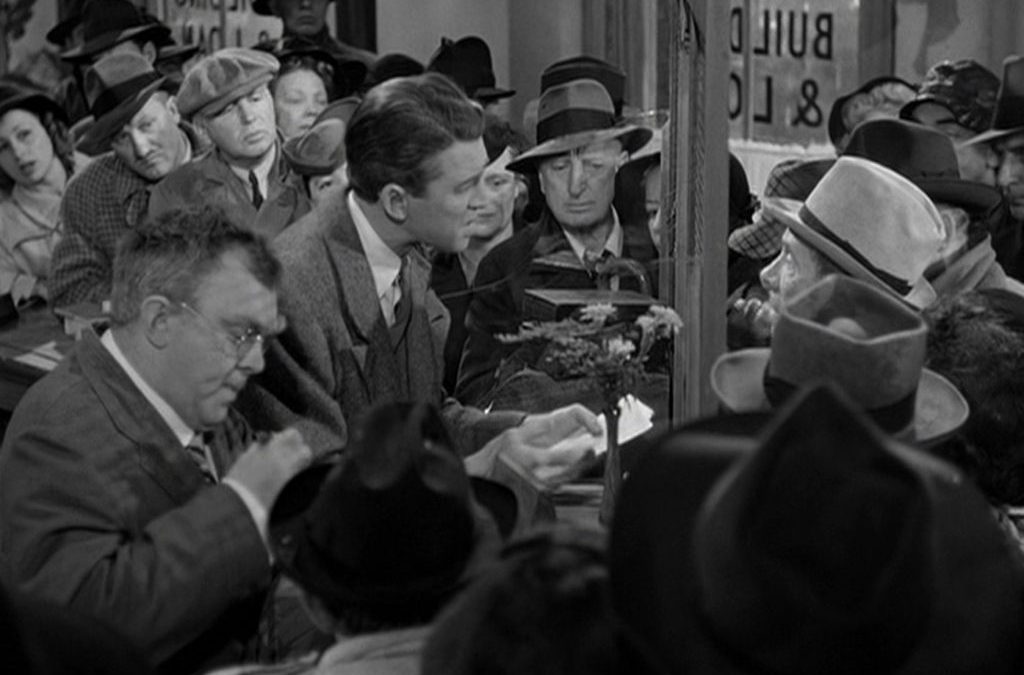
In his job as bank manager, George Bailey faces his first real challenge when his customers in the small town of Bedford Falls make a “run on the bank.” Crowding into the bank lobby at closing time on Friday, they’re all looking to withdraw their deposits, in fear the bank might go under. But Bailey Building and Loan doesn’t have the reserves to fund their withdrawals in-full.
“You’re thinking of the place all wrong, as if I have the money bank in a safe. The money’s not here,” George shares with his customers. “Your money’s in Joe’s house… and a hundred others. You’re lending them the money to build and then they’re going to pay it back to you the best they can.”
You can probably recall the scene. In a measured way, George calmly explains how banks work to this angsty group of customers. Banks receive deposits from some customers, Bailey describes, and then on-lends these funds for mortgages and loans to other customers, carefully managing their risk through an interdependent web of borrowers and depositors. But the economic commentary in the film extends far beyond just this scene. At its core, It’s a Wonderful Life examines banking at its very best and its very worst.
George Bailey did not intend to be a banker. He planned to travel the world and pursue a career of glamour and prestige far away from his hometown of Bedford Falls. But when his father dies, George forgoes these plans to protect the legacy of Bailey Building and Loan, a bank committed to serving the needs of even the most vulnerable Bedford Falls residents. Bailey saves the bank and leads it well, in spite of the bank run and an attempted hostile takeover by Henry Potter, a vulturous investor and slumlord, who wants to gobble up Bailey’s community bank and take advantage of its customers.
Mr. Potter’s banking philosophy—that banks only thrive at the expense of their customers—is a philosophy excoriated throughout the Bible, most clearly in the law God gives to Moses. Shortly after outlining the Ten Commandments, God instructs Moses on how his people should conduct financial transactions with their most vulnerable community members.
“If you lend money to any of my people with you who is poor, you shall not be like a moneylender to him, and you shall not exact interest from him.” (Exodus 22:25)
Scripture condemns charging interest in an exploitative and extractive manner, particularly to the vulnerable, like the working-class residents living in Israel and in the fictional town of Bedford Falls. The Hebrew word used to describe usury is the same word used to describe the strike of a scorpion. But George Bailey’s philosophy is quite different. At his bank, he is honest and transparent with his customers and he takes risks in banking on the members of his community, enabling both the bank and its customers to thrive. Potter’s approach is just the opposite. Potter grows his wealth by holding down and victimizing his customers.
In 1903, Maggie Walker founded St. Luke Penny Savings Bank in Richmond, Virginia. The daughter of an enslaved mother, Walker became the first black woman in our country to run a bank. And, her vision for St. Luke was not dissimilar from what’s depicted by Bailey Building and Loan. St. Luke served all customers, but was focused on those traditional banks were most prone to overlook.
“Walker knew impoverished borrowers could be honest and diligent,” writes Jason Zweig in a feature in the Wall Street Journal.
Like Bailey, she focused her bank’s efforts on helping her neighbors buy their own homes, achieving among the highest rates of homeownership in the country within the Black community. Walker’s banking philosophy extended even into the design of her bank branches.
“In the bank’s elegant interior, holding a brass pen in their hands, even the poorest customers could feel respected.”
St. Luke Penny Saving Bank and Bailey Building and Loan were cut from the same banking cloth. These examples inspire our work at HOPE International, challenging us to serve men and women beyond the paved road, in communities and neighborhoods banks still overlook. We serve in these places not out of pity, but out of our belief in the ingenuity and creativity we find there. We believe these communities are overlooked not because of a lack of local capacity, but because of a lack of opportunity.
In a turning point in It’s a Wonderful Life, Bailey finds himself once again in the office of Mr. Potter. Because Mr. Potter stole $8,000 from Bailey Building and Loan, Bailey finds himself unable to pay his bills and at Mr. Potter’s mercy. Potter offers him no grace, but instead issues an ultimatum: Jail or bankruptcy. Bailey chooses neither, leaving uncertain about how he’s going to come up with the $8,000 he needs to keep his bank afloat.
“Go to the riffraff you love so much and ask them for help,” Potter scolds Bailey, kicking him out of his office.
In the final scene of the movie, Bailey returns home to find the riffraff he loves so much—his neighbors, customers, family, and friends—have provided the very help he needs. Altogether, they chip in enough money for Bailey to fend off Potter and keep the bank open.
The jubilant Christmas party erupting in Bailey’s home encapsulates what real banking and this season are all about: The rich and the poor, the powerful and the weak, the privileged and the overlooked, all mutually interdependent as we feast and celebrate together.