by Chris Horst | Jan 18, 2010 | Blog |
This is part three of a three-part series, “How Then Shall We Help?”
It’s not just about serving and it’s not just about preaching. There’s the eleven word summary of the first two parts of the series. So…what is it about? How then shall we help? As Christians, what is our calling in a world that desperately needs the saving grace of Christ but also needs food, homes, clothing, and access to financial services?
Where better to look than the life of Christ? The story of Jesus feeding the 5,000 families is a familiar one. In John 6, we read about how Christ miraculously multiplied just five barley loaves and two fish to feed an expansive crowd. It is interesting to note Jesus’ motivation for this act. “When Jesus went ashore he saw a great crowd, and he had compassion on them” (Matt 6:34). Christ’s act of love and service to the people flowed out of the compassion of his heart.
The word “compassion” is used many times to describe Jesus’ ministry. We read later in Matthew that “Jesus had compassion on the crowds and healed their sick” (Matt 9:36). Literally, the Greek word used in these passages means “to be moved by compassion.” There is greater richness in this word than can be gleaned at first glance. Charles Spurgeon describes it this way:
The original word is a very remarkable one…It is expressive of the deepest emotion; a striving of the bowels—a yearning of the innermost nature with pity…I suppose that when our Savior looked upon certain sights, those who watched him closely perceived that his internal agitation was very great, his emotions were very deep, and then his face betrayed it, his eyes gushed like founts with tears, and you saw that his big heart was ready to burst with pity for the sorrow upon which his eyes were gazing. He was moved with compassion.
Christ exhibited in this story a “yearning of the innermost nature.” When is the last time you had that sort of deep emotional churning deep in your gut? Jesus felt it often. He looked out over crowds of people—the sick, the hungry, the beaten-down—and was moved with compassion. We read in this specific story that Jesus went on to feed the crowds of hungry people. But, Jesus’ ministry did not end there.
Later in the day, Jesus left with his disciples and sailed to the other side of the sea. The crowds followed him. When they found him, Jesus offered these poignant words (John 6:25-27, 35). “You are seeking me…because you ate your fill of the loaves. Do not labor for the food that perishes, but for the food that endures to eternal life…I am the bread of life; whoever comes to me shall not hunger, and whoever believes in me shall never thirst.” First, we met Jesus the social worker. Now, Jesus the evangelist. He fed the crowds…and shared the Gospel. Matthew 24:19 described Jesus as “a man who was a prophet mighty in deed and word.”
And there we have it. In this brief snapshot of Jesus’ life in John 6, we have our answer. As Christians, we are called to give bread and to proclaim the Bread of Life. It should never be separated. Jesus fed the five thousand, healed the sick, spoke against racism, and defended the cause of the outcasts in society. Moved by compassion, he provided bread. And, he demonstrated the absolute necessity for heart change. I am the bread of life.
Theologian Christopher Wright says it beautifully: “It is not a matter of engaging in both the gospel and social action, as if Christian social action was something separate from the gospel itself…Biblically, the gospel includes the totality of all that is good news from God for all that is bad news in human life—in every sphere..” It is not an either/or. It is a both/and. Not one without the other. Word and deed. Evangelism and service. Bible-translation and microfinance. Clean water and church plants. Hospitals and seminaries. Adoption and Christian youth camps. The seen and the unseen. Bread and bread of life.
by Chris Horst | Dec 22, 2009 | Blog |
This is part two of a three-part series, “How Then Shall We Help?”
Last month I stated that decreased suffering does not necessarily follow increased prosperity. In many cases, increased prosperity simply leads to new kinds of suffering. Helping our neighbors materially is not enough. It would be easy to assume from those reflections that the answer to the question, “How then shall we help?” would be this: Plant churches, hold evangelistic crusades, distribute Bibles, and get people saved. As Jesus said, “For what will it profit a man if he gains the whole world and forfeits his soul?” (Matt 16:26) Why, then, does HOPE waste its time doing economic development when it could be focusing solely on the real work of preaching the Good News? The core issue here is whether our efforts should focus unilaterally on the spiritual condition of humanity.
The truth is this: We cannot ignore our clear call to generously give to the poor—and not just because it amplifies our words. Throughout Scripture (over 2,000 biblical passages) we are called to help the poor in tangible, material ways. Humans are not simply spiritual beings which happen to exist in a physical state. The needs of the present must be met while we seek to address the needs of the eternal. Why?
- The Bible says our faith is void without it. “If a brother or sister is poorly clothed and lacking in daily food, and one of you says to them, “Go in peace, be warmed and filled,” without giving them the things needed for the body, what good is that?” – James (James 2). Viewing compassion and justice as a “means to an end” (to get people saved) illustrates a troubling disconnect between body and soul. Our concern for the poor should be a natural and generous outpouring of our hearts, which have been transformed by Christ. As James said, if we ignore suffering, of all types, in our communities here and abroad, even if we share an encouraging word, “What good is that?”
- The historical Christian Church has embodied it.”Nothing has contributed to the progress of the superstition of the Christians as their charity to strangers…they provide not only for their own poor, but for ours as well.” –Julian. As the anti-Christian leader of the Roman Empire, Julian made this comment in 360 A.D. History indicates that the early Church saw people as more than spiritual beings. It was that radical generosity which provided fuel to the message of Christ. Early Christians, it seems, as Tim Keller describes, “were promiscuous with their charity” and it showed in the Church’s rapid growth in that time.
- Jesus taught and practiced it. “Which of these three, do you think, proved to be a neighbor to the man who fell among the robbers?” – Jesus, in the Parable of the Good Samaritan. Jesus, as Creator and Almighty God, chose to come and live among us, the poor. His Incarnation alone speaks to His concern for more than just our souls. He came from heaven to live among us on earth. While on earth, he healed the sick, befriended street-dwellers and prostitutes, and cared for the poor. In response to Jesus’ question above, someone in the crowd answered, “The one who showed him mercy.” Jesus replied to him, and to us, “You go, and do likewise.”
There is a problem if we view our sole purpose as Christians to proclaim the Gospel verbally. It illustrates a severe disconnect if we overlook the physical, emotional and social condition of our neighbors in our attempts to introduce them to Jesus. Further, our acts of service must not be viewed as a “means to an end.” Certainly, radical generosity opens doors to proclaim the Gospel. But, the Good Samaritan was not heralded because his mercy led to a conversion. He was heralded because countercultural compassion is the only appropriate response from a person whose heart has been transformed by the love of Christ. Thankfully, this is not an either/or proposition.
Next month, final reflections in the series, “How Then Shall We Help?”
by Chris Horst | Nov 17, 2009 | Blog |
This is part one of a three-part series, “How Then Shall We Help?”
“It was an amazing mission trip. I can’t tell you how happy and content all the people were despite how little they had.”
Have you heard comments like this before? Have you said this before? I have said it several times. It’s a recurrent reflection after trips to poor countries because it is compelling to see joy in the faces of children, parents and grandparents despite their modest means. I specifically remember a joyful little boy from my last trip to the Dominican Republic who was running around wearing nothing but a ratty, tattered t-shirt. His face was dirty, he had few possessions, but, in the midst, he was content.
I have been thinking a lot about this the past few months. Christians in this country, I think, recognize we are called to help the poor. Biblically, there is almost no book in scripture devoid of God’s commands to care for the less fortunate. And, even in our secular culture, it is in vogue to care about “social justice.” It is hip to care about Africa and to buy fair trade coffee. My concern is in the outcome of this groundswell of excitement in “giving back.” I believe the end-game for Christians, often, is supporting any program, project or initiative which increases the prosperity of the poor.
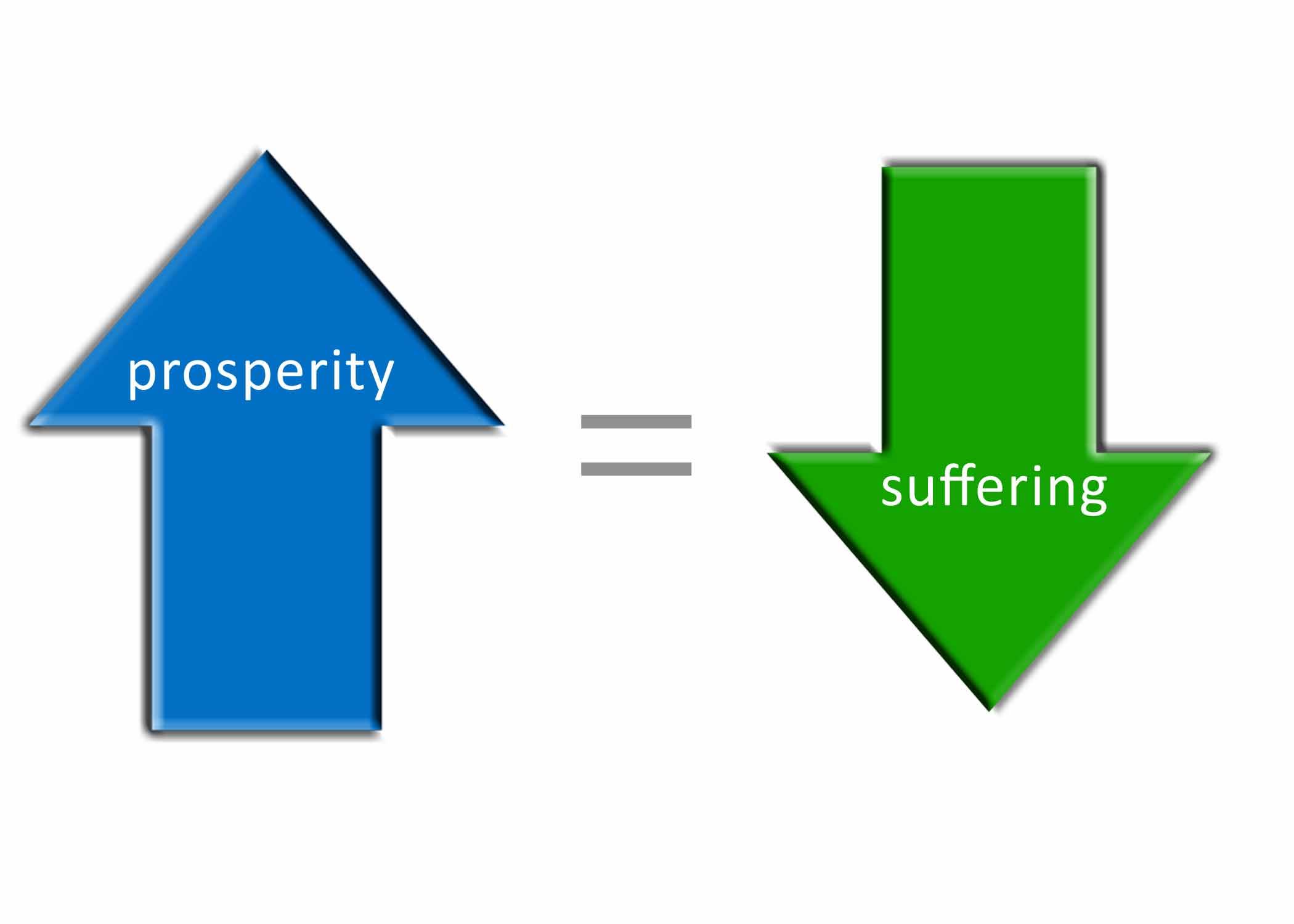
The line of reasoning goes like this: Increased prosperity leads to decreased suffering.
At first glance, I agree with this statement. There are poor people in this world. As Christians, we are called to help them out. We help them by providing education, medical care, housing, language training, business loans, savings accounts, and clean water—all to help them increase their prosperity. As a result, this line of reasoning states, their suffering decreases. Increased prosperity leads to decreased suffering, right?
What if, however, when we help those poor, happy, underprivileged families by providing them with things, they develop some of the same issues our over-privileged children have? Entitlement, jealousy, materialism, obesity, greed. What if, in our attempts to help, rather than decreasing it, suffering just takes on a new identity? I believe most American Christians would agree that increased financial prosperity does not lead to increased fulfillment. We do not have to look beyond our own families and friends to know that material wealth has very little influence on personal joy, satisfaction or success. But, it seems to me that reality has little bearing or influence on our attempts to help the poor.
Now, don’t get me wrong. I work for an organization which helps the poor. I absolutely believe we are to sacrificially serve and “give back” to those in our communities and to those around the world. But, just helping people increase their prosperity cannot be our end-game. In fact, helping the poor does not always decrease their suffering. Next month I will continue to explore these issues while grappling with the question: How then shall we help?
